
DC Gear Motor Specifications Explained | RPM, Torque, Ratio
DC gear motor specifications have a fixed reading order, and reading them out of order is the most common reason a motor gets ordered twice. A gear motor datasheet contains two machines in one document: the DC motor, whose figures describe the motor shaft, and the gearbox, whose ratio converts those figures into output speed and output torque. Start with the rated voltage, then the gear ratio, then the speeds, then the torques, then the currents, and finish with duty cycle and life. Everything before the ratio belongs to the motor. Everything after it belongs to the output shaft.
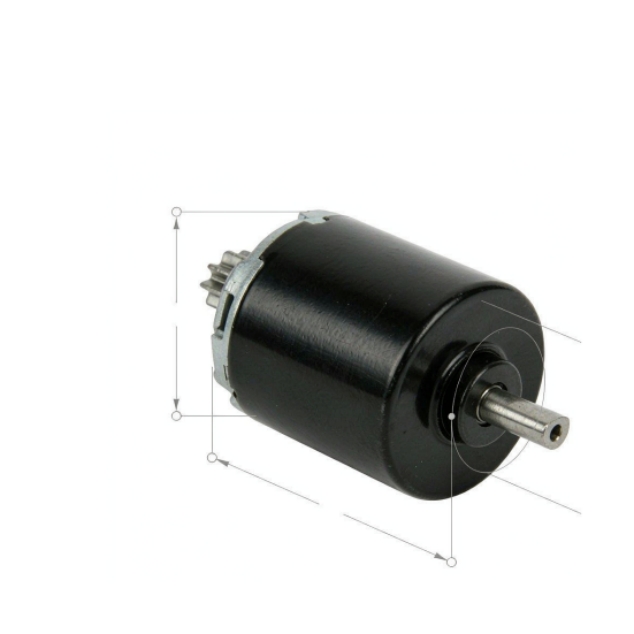
DC gear motor on a white background with dimension lines and measurement callouts indicating length, diameter and output shaft, illustrating how to read motor specifications.
This article walks through that order, explains the trap hidden in each field, and lists what to send a supplier so that the first sample is the right one. It applies to any DC gear motor series, whether the sheet in front of you is a catalogue page or a quotation for a custom variant.
Reading DC gear motor specifications in the right order
Step | Field | What it tells you | Common trap |
1 | Rated voltage | The supply the figures were measured at | Mixing figures measured at different voltages |
2 | Gear ratio | Reduction between motor shaft and output shaft | Assuming the ratio alone predicts output speed without knowing motor speed |
3 | No-load output speed | Output speed with nothing attached | Using it as the working speed; the output slows under load |
4 | Rated output speed | Output speed at the rated load | Reading it without the load that defines it |
5 | Rated output torque | Continuous torque at the rated point | Treating it as a peak capability |
6 | Stall output torque | Torque at zero output speed | Using it as a working point |
7 | Rated and stall current | Supply and driver sizing | Sizing the supply on the running figure and ignoring start-up |
8 | Gearbox type | Spur, planetary or worm | Comparing ratios across types without comparing efficiency and behaviour |
9 | Output shaft | Diameter, length, flat or keyway | Discovering the interface mismatch at assembly |
10 | Duty, noise and life | Thermal and acoustic limits | Assuming a free-air continuous rating applies inside a sealed enclosure |
Speeds: no-load, rated, and under your load
A gear motor datasheet usually gives at least two speeds. No-load output speed is what the output shaft does with nothing attached. Rated output speed is what it does while delivering the rated torque. The working speed in your machine is neither of those unless your load happens to match the rated point exactly.
The conversion itself is easy. Output speed equals motor speed divided by the gear ratio. If the gearbox ratio is 1:32, the output turns at one thirty-second of the motor speed. What is easy to forget is that the motor speed itself falls as load rises, so the output speed falls twice over: once through the ratio, and again through the motor's own speed drop under load. Design at the speed you need with the load attached.
An illustrative calculation, not a catalogue figure: if a motor is quoted at 10,000 rpm with no load at the measurement voltage, and the ratio is 1:32, the no-load output speed is about 312 rpm. Under a load that pulls the motor down to 8,000 rpm, the same gearbox delivers about 250 rpm. The ratio has not changed — only the motor's operating point has.
Torque: rated, stall, and what the gearbox does to both
Output torque is approximately motor torque multiplied by the gear ratio, less the losses inside the gearbox. Those losses differ by type: a worm gearbox loses more than a planetary or spur stage of the same ratio. That is why the same ratio from two different gearbox types does not deliver the same output torque, and why worm designs behave differently when the load tries to drive the output backwards. Whether a particular worm configuration holds position with the motor unpowered is a configuration-dependent question, and it should be confirmed with the factory rather than inferred from the ratio.
Rated output torque is the continuous figure: what the motor and gearbox can deliver at the stated duty without exceeding their thermal limits. Stall output torque is what the output can apply when it is held against rotation. Stall is a limit for the gearbox, not a working point — held at stall, the motor's input turns into heat in the windings, and at high ratios the gear teeth carry their maximum load.
That gap between rated and stall torque is why one gear motor can look powerful on a specification sheet and disappointing in a machine. Size the continuous demand against rated output torque, and treat stall as starting headroom rather than as capacity.
Current, duty cycle, and the two thermal questions
Current draw has two values of interest. The current at the rated operating point sets your average supply requirement; the stall current is what the supply and any driver must survive briefly at start-up and if the output jams. A gear motor starting against a load draws its highest current in the moment before the output reaches speed, so the supply has to be sized for that moment, not only for the running figure.
Duty cycle then decides what continuous means for your product. A rating measured in free air will not hold inside a closed housing with no airflow, and a gearbox that is efficient on paper still adds heat. Ask for the duty and the ambient temperature attached to the figures, and if your enclosure is sealed, say so at the start.
Three misuses worth naming
1. Using no-load speed as the working speed. The output slows under load, and the more torque you take, the more it slows.
2. Treating stall torque as usable torque. Stall is where rotation stops, so the torque available there is not available while the output is turning.
3. Comparing ratios across gearbox types. A 1:50 worm, a 1:50 planetary and a 1:50 spur stage are not interchangeable: efficiency, backlash, noise and behaviour under a reverse load all differ.
Variants, and what to send so the first sample is correct
Two DC gear motor variants with the same ratio, the same voltage and the same frame can still have different specifications, because the winding, the gearbox type and the lubrication inside them differ. That is why a template of requirements is more useful to a supplier than a preferred part number.
One requirement deserves to be raised early: if the application needs to know how fast the output is actually turning, for closed-loop speed control or for counting rotation, that is a different configuration from a plain gear motor. Hofon's DC gear motor line can be supplied with a hall encoder fitted, and gear motors with a hall encoder are listed as a separate family — easier to specify at the start than to retrofit later.
Input | What to state |
Supply | Nominal and minimum voltage, and the current your supply or driver can provide |
Output speed | Target output rpm under load, with a tolerance |
Output torque | Continuous torque at that speed, plus any start-up or peak requirement |
Duty | Run and rest pattern, and the expected life of the product |
Mounting and interface | Output shaft diameter, flat or keyway, mounting pattern, available envelope |
Noise | Any acoustic ceiling, since gearbox type and lubrication both affect noise |
Environment | Ambient temperature, moisture and dust exposure |
Feedback | Whether speed or position feedback is required, which changes the configuration |
Finally, separate the catalogue from the custom. Voltage, ratio and frame combinations are normally catalogue items; Hofon's product pages state that materials and performance parameters can be customised. When you receive a sheet for a custom variant, confirm in writing the ratio, any shaft modification, the lead length and the operating point at which the ratings were taken — those are the four items that most often differ from the catalogue sheet.
Conclusion
DC gear motor specifications are readable in one pass if you keep the order: voltage, ratio, speeds, torques, currents, duty. Remember that a gear motor is two machines in one housing, that the ratio converts motor figures into output figures rather than replacing them, and that rated and stall values answer different questions. Read in that order, figures that look inconsistent — the same model quoted with different rpm and torque by two suppliers — usually turn out to have been measured at a different operating point, a different ratio or a different duty, rather than to be in conflict.
If a quote needs checking, send your speed and torque requirement to Hofon with the duty cycle and the mounting constraints; we will confirm which ratio and frame combination covers it, and which figures are continuous and which are momentary.