
Stepper vs Servo Motor: Differences and How to Choose
Stepper motor vs servo motor is decided by four things, and accuracy is only one of them. If the axis moves slowly, holds a position against a load, and can live with open-loop control, a stepper is the simpler and cheaper answer. If the axis has to accelerate hard, run at speed, correct itself continuously and report its position, a servo is the answer. Everything else in the comparison — torque curves, drives, cabling, commissioning — follows from those two cases.
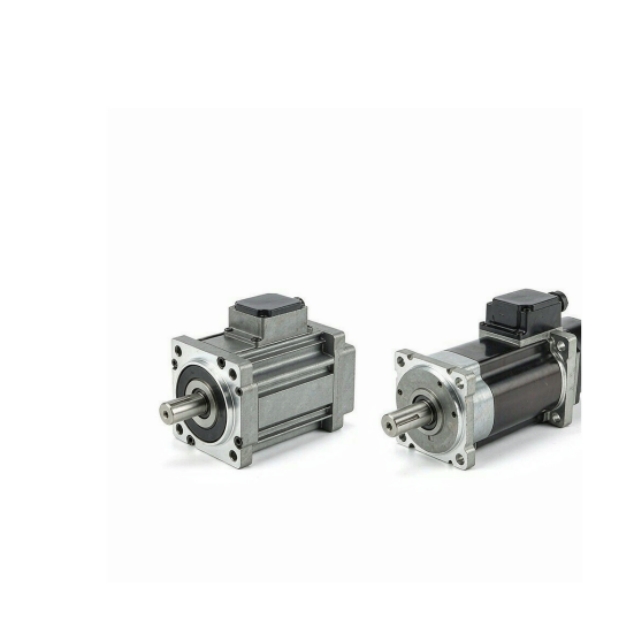
Side by side comparison of a square stepper motor and a cylindrical DC servo motor with rear encoder, on a white background.
Stepper motor vs servo: the four differences that decide it
Dimension | Stepper | Servo |
Control loop | Normally open loop: the drive counts pulses and assumes the rotor followed | Always closed loop: an encoder or resolver reports position continuously |
Torque and speed behaviour | Torque falls as speed rises; beyond a certain speed the rotor cannot follow and the axis loses steps | Holds torque over a wide speed range, then runs in a constant-power region |
Control complexity | Step and direction pulses from a PLC, MCU or indexer; no tuning in the basic case | A servo drive plus tuning of position, velocity and current loops, often over a fieldbus |
Cost structure | Low drive cost, no feedback device, low commissioning effort | Higher drive cost, feedback device, more wiring, commissioning time |
Torque and speed behaviour
A stepper produces its highest torque at low speed and loses torque as speed rises, because winding inductance limits how quickly current can be established in each step. That relationship is normally shown as a pull-in and pull-out curve, and the number that matters is the usable torque at your required speed — not the holding torque, which is measured with the shaft stationary and says nothing about behaviour while the motor is turning.
A servo holds roughly constant torque up to its rated speed and then runs at constant power, so it can accelerate a load quickly and hold speed against a load that varies through the cycle. That is the reason servos appear in applications with fast moves or with loads that change during the profile.
Feedback, and what happens when something goes wrong
The most consequential difference is not the motor, it is the loop. A stepper in open loop has no way to know that the rotor did not follow its pulses. If the demanded acceleration exceeds the torque available, or a transient load spike arrives, the axis loses steps and carries on from the wrong position, silently. The machine keeps producing parts that are out of position until somebody inspects them.
A servo knows its position at all times and drives the error toward zero. It also produces a following-error signal, so an axis being pushed beyond its capability can raise a fault instead of quietly producing bad parts. Where a process cannot tolerate silent position loss, that capability is worth more than a torque margin on paper.
A third option sits between them: a stepper can be run closed loop with an encoder, which gives it some fault detection while keeping a step-and-direction command interface. That is a different comparison from open-loop stepper versus servo, and it should be evaluated as its own case rather than folded into this one.
Cost, including the parts that are easy to forget
Comparing the price of a stepper motor with the price of a servo motor is not a comparison. The relevant total includes:
·The drive. A step-and-direction driver against a servo drive is the single largest difference in the sum.
·Feedback. A servo needs an encoder or resolver; an open-loop stepper needs none.
·Power supply and cabling. Servo systems usually need more current capacity and more conductors, often with shielded cable for the feedback signal.
·Commissioning. Servo axes have to be tuned, and that effort scales with the number of axes and the stiffness of the mechanics.
·Scrap and rework. An open-loop stepper that loses steps without reporting it can produce a whole batch of out-of-position parts before anyone notices.
At the low end the stepper is clearly cheaper. The further an axis moves toward fast, accurate motion under a varying load, the more of that difference a servo earns back. Neither figure can be settled without the drive and the commissioning time in the sum.
Where a geared stepper changes the answer
One part of the comparison is often skipped: what happens when a gearbox is added to the stepper. Reduction multiplies the usable output torque and lowers the speed the motor has to run at, which keeps the motor in the region of its curve where torque is still available. For axes that are slow but need real torque, a geared stepper motor can meet a requirement that a bare stepper cannot and a servo would over-serve — and it does so without an encoder or tuning.
A geared stepper is not a servo. It still does not know its position, and it still adds backlash. But for a slow axis with a known and largely constant load, it is frequently the right level of engineering.
Decision checklist
Work through these seven items in order. The answer is usually determined by the first two.
1. Speed range. If the axis must run fast for a significant part of the cycle, the stepper's torque drop is normally decisive.
2. Accuracy and repeatability. State the tolerance in the axis, not in the motor. If open-loop positioning with a gearbox already meets it, the servo's extra loop buys nothing.
3. Load and inertia. Heavy loads and high reflected inertia need torque and control that favour the servo, or reduction on the stepper.
4. Move profile. Hard acceleration and short moves need torque reserve at speed, which is the servo's strength.
5. Load variability. A load that changes within the cycle favours a closed loop.
6. Duty and environment. Continuous duty inside a warm enclosure changes both options.
7. Budget as a totality. Motor, drive, feedback, cabling, commissioning, and the cost of a silent position error.
A useful test: ask whether anything in the machine will notice if the axis ends up somewhere other than where it was sent. If nothing notices, the servo's loop may be solving a problem you do not have. If the process depends on it, the loop is the feature you are buying.
Conclusion
The stepper motor vs servo decision is a trade between an open loop that is simple, cheap and silent about its own failures, and a closed loop that costs more and tells you what it is doing. The stepper wins on slow, cost-sensitive axes with largely constant loads; the servo wins where speed, acceleration or a varying load makes position loss unacceptable. Before comparing prices, put the drive, the feedback device and the commissioning time into the same table — and remember that a geared stepper is a legitimate third answer for slow, high-torque axes.
If you would rather have the axis assessed than argued about, discuss your axis requirement with Hofon— send the stroke, the load, the move profile and the required speed, and we will tell you which side of this boundary the application sits on.