
Brushed vs Brushless DC Motor: Differences, Cost and Choice
Brushless vs brushed motor is not a contest between an old design and a new one. It is a trade. A brushed motor turns electrical energy into rotation using a mechanical switch that wears out; a brushless motor moves that switching into electronics that cost more up front but rarely need service. Which one belongs in your product depends on duty cycle, service access, acoustic and electrical noise limits, and how much of the total cost you are willing to carry in the drive electronics rather than in the motor itself.
This guide compares the two on the dimensions that actually change a design decision, and shows how to put a number on the comparison instead of arguing about which technology is better.
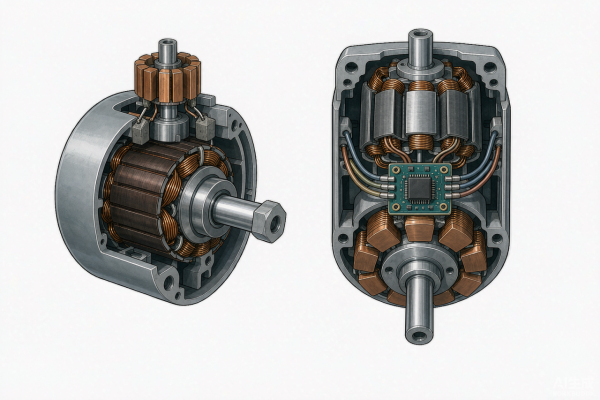
Cutaway comparison of a brushed DC motor with commutator and brushes beside a brushless DC motor with stator windings and an electronic controller
Brushed vs brushless: how the two motors commutate
Every DC motor has to reverse the current in its windings at the right moment to keep the rotor turning. The two families do that in fundamentally different ways.
·Brushed motor: permanent magnets form the stator and the windings sit on the rotor. Current reaches those windings through carbon brushes sliding on a segmented commutator, so the reversal is mechanical and tied to rotor position.
·Brushless motor: the magnets rotate and the windings are stationary. A controller reads rotor position — from Hall sensors or from the back-EMF of the unpowered winding — and switches the phase currents electronically.
The practical consequence is the presence or absence of a sliding electrical contact in the power path. Hofon Precise Motor manufactures both brushed micro DC motors and brushless motors, and the micro DC motor range is organised by frame diameter, which is usually the first thing an engineer pins down.
Efficiency, life and maintenance
The differences in efficiency and service life follow from that construction difference, not from marketing.
In a brushed motor, energy is lost at the brush contact: there is a voltage drop across the brush-commutator interface, friction between brush and commutator, and arcing as the brush bridges adjacent segments. Some of that heat is generated in the rotor, which is the hardest part of the motor to cool because it sits inside the stator, across an air gap. Brushless motors remove the sliding contact, and because the windings are in the stator, the heat they produce has a direct path through the lamination stack into the housing. That is why, at a similar size, a brushless motor generally runs cooler and converts a larger share of its input into shaft power.
Life is limited by different parts. A brushed motor's service life is normally set by brush wear, and the wear rate depends on speed, current, humidity and the dust the motor ingests, so brush life has to be quoted for a specific application and cannot be read across from another design. A brushless motor has no brush to replace, so its life is normally decided by the bearings and by the controller electronics. Note that longer brushless life is a general principle, not a specification: a brushless motor with an undersized bearing or a hot-running driver can fail earlier than a well-applied brushed unit.
Maintenance follows the same pattern. Brushes are a wear item. On a motor that can be reached, they can be replaced; inside a sealed micro drive that is assembled into a closed product, a worn brush effectively means replacing the assembly.
Dimension | Brushed DC motor | Brushless DC motor |
Commutation | Mechanical — brushes on a segmented commutator | Electronic — controller switches phases using rotor position |
Sliding electrical contact | Yes, at the brush-commutator interface | No |
Heat path from the windings | Partly from the rotor, which is hard to cool | From the stator, directly into the housing |
Wear item | Brushes, plus bearings | Bearings and drive electronics |
Electrical noise | Arcing produces broadband EMI | Controller switching noise, more predictable and easier to filter |
Usable speed range | Limited by arcing and brush lift-off | Higher, because there is no sliding contact to lift |
Drive requirement | Runs directly from a DC supply; speed set by voltage or PWM | Needs a dedicated controller and rotor position sensing |
Cost structure | Lower unit cost, no electronics | Higher unit cost plus controller cost |
The comparison that matters: total cost
The usual summary — brushed is cheaper, brushless is better — compares only the motor. A design decision needs the whole cost of ownership:
total cost = (motor unit cost x quantity) + controller and sensing cost + (service events x cost per event) + downtime cost
·Brushed: the controller term is close to zero, but the service term is not. Every brush replacement consumes labour, and if the product is not designed to be opened, it consumes the whole assembly.
·Brushless: the controller term is real and does not shrink as the motor gets smaller, so on very small frames the electronics can cost more, and occupy more volume, than the motor itself.
·Both: downtime carries a different weight depending on who pays for it. A failed motor in a hand-held accessory is an inconvenience; a failed motor on a machine that stops a production line is a different order of cost.
The crossover point therefore depends on duty hours, on whether the motor is accessible for service, and on the required life. Long duty, no service access and a long life target push the calculation toward brushless. Short duty, low cost targets, and a product that will be replaced before the brushes wear out, push it toward brushed. The actual figures have to come from your supplier's quotation and your own service data; the framework above tells you which terms to collect.
Where each type fits
·Brushed fits: intermittent duty, simple or single-speed operation, supplies that are a battery or a basic adapter, low unit cost targets, and products whose service life is short relative to brush wear.
·Brushless fits: continuous or long duty, higher shaft speeds, low acoustic and electrical noise requirements, speed or position regulation, sealed assemblies where service is impractical, and drives that must run unattended for a long service interval.
Miniaturisation deserves a note of its own. As frames get smaller, fitting a controller and position sensing becomes harder, and the electronics stop scaling down with the motor. For a small, lightly loaded, short-duty actuator, a brushed micro motor is often the more practical engineering answer — even though brushless is the better answer for the same frame running continuously.
There is no rule that says brushless wins at every size; frame size and duty cycle have to be judged together. Hofon's brushless motor range covers inner-rotor and outer-rotor designs as well as brushless gear motors, for engineers who need that route instead of a brushed unit.
What to send when you ask for a comparison
If you are weighing the two options with a supplier, the useful input is the operating condition, not a preference. Send:
1. Duty cycle in hours per day, or the run-to-rest ratio, and whether the load is continuous or intermittent.
2. Required output speed and the torque needed at that speed, including any short acceleration peaks.
3. Supply voltage, available current, and whether a controller can be accommodated in the enclosure.
4. Acoustic and EMI limits, including whatever screening your product has to pass.
5. Service access: can the motor be reached, and is a replacement assembly acceptable?
6. Expected product life, and the cost of a field failure.
7. Volume and any production schedule constraint.
With those seven inputs the brushed-versus-brushless decision usually resolves itself into a clear answer. Without them, either choice is a guess.
Summary
The brushless vs brushed motor decision reduces to three questions: how many hours the motor will run, whether anyone will be able to service it, and how much the design can spend on electronics. Brushed wins on cost and simplicity when duty is short and the product will not outlive its brushes. Brushless wins on efficiency, life and quiet operation when duty is long and service is impractical. Compare total cost rather than unit price, and use the seven inputs above to make the comparison real.
If you are still undecided, send your duty cycle and life target to Hofon and we will tell you plainly which of the two routes we would build for your application, and where the boundary between them sits.